
Facility Threat Reviews
On-site threat and vulnerability assessment of how a facility can be reached, entered, and disrupted. Approach paths, standoff, entry points, existing protection, and incident exposure documented into a facility-specific review used for board decisions, capital planning, grant applications, and insurance requirements.
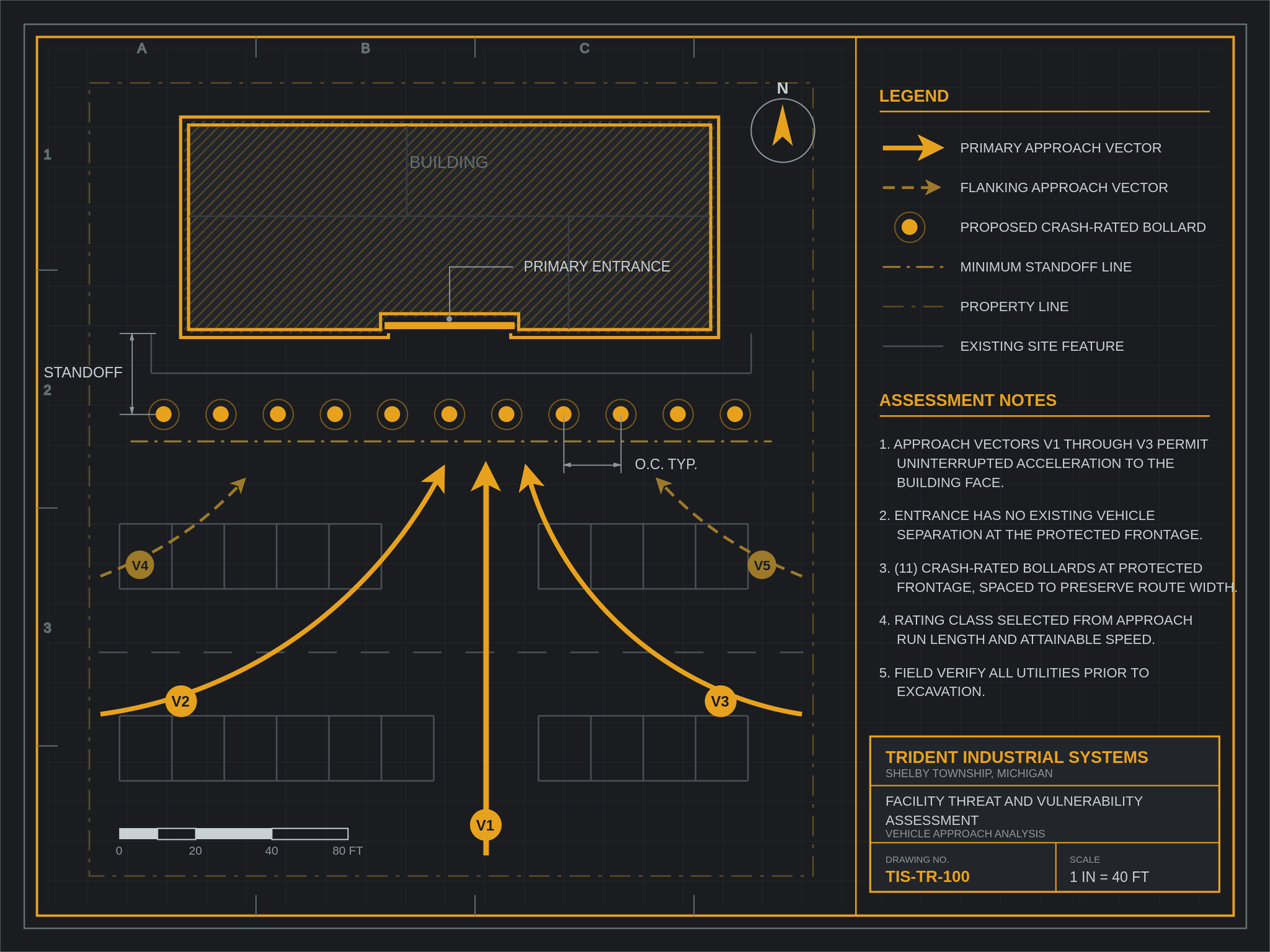
Threat and Vulnerability Assessment
Trident assesses how a facility is exposed and documents what closes it. Assessments are performed on site, scoped to the facility rather than to a checklist, and delivered as a single document a facility owner can act on.
Most facilities have never had an assessment of any kind. The ones that have usually have a report on doors, cameras, and procedures, and nothing on how a vehicle reaches the building.
THE INCIDENT RECORD
Vehicle-into-building strikes are common, geographically distributed, and underreported as a category. They occur in urban, suburban, and rural locations at comparable rates, and the record includes buildings struck more than once at the same address.
Accidental Strikes
Pedal error, medical events, impaired driving, and loss of control account for the majority of vehicle-into-building incidents. Storefronts, entrances, drive-through lanes, and parking-adjacent facades are the most frequently struck locations. These incidents follow no threat pattern and cannot be deterred by policy, staffing, or surveillance.
Intentional Strikes
Ram-raid theft, targeted attacks on assembly points, and vehicle-as-weapon incidents at gatherings and events. These follow a different pattern, concentrate at different times, and are the category most facilities are thinking about when they start looking at protection.
Why the Distinction Does Not Change the Fix
The cause of a strike is unknowable from inside the building at the moment of impact. Damage, closure, structural review, occupant displacement, and liability exposure follow either one, and the physical protection that prevents them is identical. A facility that hardens against accidental strikes has hardened against intentional ones.
Repeat Exposure
Buildings struck once are frequently struck again, because the condition that caused the strike is a site condition. Approach geometry, drive alignment, parking orientation, and speed on adjacent roads do not change after an incident unless something is installed to change them.
What the Assessment Covers
Vehicle approach and standoff. Every vehicle approach to the building, achievable speed at impact from run-up distance and grade, and standoff measured from each approach to occupied space.
Perimeter and access. Property line integrity, gates and openings, unmanned entry points, parking and drive circulation, and where the perimeter can be crossed on foot or by vehicle.
Entry and interior. Entrance geometry, vestibule and reception control, secondary and service doors, after-hours access, and interior areas requiring separate control.
Existing protection. What is installed, whether it carries a rating, and which approaches it actually closes. Partial protection is the pattern, and it is usually the finding that matters most.
Electronic systems. Access control, video coverage, detection, and notification, evaluated for gaps and for whether the systems in place are integrated or operating independently.
Event and assembly exposure. How exposure changes during services, dismissal, games, festivals, and other periods when occupancy and outdoor gathering concentrate.
Findings and design basis. Prioritized findings, the protection class required at each exposure, spacing and standoff requirements, site constraints from utilities and structure, and a phased sequence where the work cannot be done at once.
Assessment Types
-
Church Threat and Vulnerability Assessment. Parking-side facades, entry vestibules, and sanctuary approaches.
Synagogue Threat and Vulnerability Assessment. Entry standoff, event exposure, and adjacent-street approaches.
Mosque Threat and Vulnerability Assessment. Entry standoff, prayer-hall approaches, and event exposure.
Temple Threat and Vulnerability Assessment. Entry standoff and gathering areas for any faith tradition.
Religious School and Preschool Assessment. Religious schools, weekday preschools, and Sunday-school facilities.
Denominational Facility Assessment. Diocesan offices, denominational headquarters, and multi-congregation campuses. -
K-12 School Threat Assessment. Student pickup zones, main entrances, and playground perimeter exposure.
Private School Assessment. Private and independent K-12 facilities.
Catholic School Assessment. Catholic K-12 schools and diocesan school systems.
Lutheran School Assessment. Lutheran K-12 schools and affiliated congregational schools.
Christian School Assessment. Christian and non-denominational K-12 facilities.
Jewish Day School Assessment. Jewish day schools and affiliated congregational schools.
Islamic School Assessment. Islamic schools and affiliated masjid schools.
Charter School Assessment. Charter K-12 facilities.
University and College Campus Assessment. Academic buildings, student unions, and residence halls.
Community College Assessment. Community college campuses and satellite locations.
Daycare and Preschool Assessment. Daycare centers, preschools, and early childhood facilities, including playground perimeter exposure.
After-School Program Assessment. After-school programs, day camps, and youth center facilities. -
Museum Assessment. Museums, cultural institutions, and heritage facilities.
Library Assessment. Public and academic library facilities.
Community Center Assessment. Community centers, cultural centers, and multi-purpose public buildings.
Event Venue Assessment. Event centers, banquet halls, and rented gathering spaces.
Concert and Performance Venue Assessment. Concert halls, theaters, and performance venues.
Sports and Recreation Facility Assessment. Gyms, recreation centers, and sports facilities with public exposure. -
Government Building Assessment. Federal, state, and municipal government buildings.
Municipal Facility Assessment. City halls, township offices, and public administration buildings.
Courthouse Assessment. County and municipal courthouses.
Hospital and Medical Campus Assessment. Hospitals and medical campuses, including emergency department entrances and ambulance bays.
Medical Office Building Assessment. Outpatient facilities and medical office buildings.
Bank Branch Assessment. Bank branches, credit unions, and ATM-side facilities.
Corporate Office Assessment. Corporate offices, headquarters, and business parks.
Manufacturing Facility Assessment. Manufacturing facilities and industrial campuses.
Data Center Assessment. Data center facilities and critical infrastructure sites.
Retail Center Assessment. Shopping centers, retail plazas, and storefront-concentrated developments.
Cannabis Dispensary Assessment. Licensed cannabis retail facilities. -
NSGP Application Assessment. Prepared alongside a FEMA Nonprofit Security Grant Program application.
School Safety Grant Assessment. Prepared alongside a state school safety grant application.
STOP School Violence Grant Assessment. Prepared alongside a federal STOP School Violence Act grant application.
Post-Incident Assessment. Prepared after a vehicle-into-building incident at or near the facility.
Premises Liability Assessment. Prepared to inform premises liability posture.
Insurance Requirement Assessment. Prepared to satisfy commercial insurance carrier documentation requests.
Pre-Construction Assessment. Prepared during design so protection is specified before the site is built rather than retrofitted after.
Multi-Site Portfolio Assessment. Prepared across a portfolio of facilities with prioritized ranking across locations.
Also searched as: security vulnerability assessment, physical security assessment, site security survey, vehicle site assessment, vehicle mitigation design, hostile vehicle mitigation assessment, vehicle vulnerability assessment, vehicle barrier specification consultation, perimeter security assessment, facility security survey.
Service Area
Trident serves commercial, industrial, and institutional facilities across Southeast Michigan and Northern Ohio, with core coverage in Wayne, Oakland, Macomb, Washtenaw, Livingston, Monroe, and St. Clair counties.
Common Questions
-
Partial protection is the pattern. An assessment documents every approach a vehicle could take to a specific building and identifies the ones the existing protection does not close. The output is a specific, documented answer to whether the current perimeter is sufficient.
-
It is a decision document. It gives a facility owner the information to brief a board, prioritize capital, respond to a carrier or grant administrator, and specify installation scope.
-
Yes. The physical and electronic protection described in the assessment is the scope Trident designs, supplies, and installs. A facility that engages Trident for an assessment moves into installation with the specification, standoff, placement, and rating already documented. Installation is a separate scope and a separate engagement.
-
Grant programs vary in what they require, and several require a documented vulnerability assessment as part of the application. Trident produces the assessment as a standalone deliverable whether or not a grant is involved, and confirms current program requirements at scoping.
-
Yes. Perimeter, entry control, interior areas, electronic systems, and event exposure are assessed whether or not vehicle approach is a factor at the site.
-
The on-site walk is scheduled around facility operations. Delivery of the completed document follows, and the timeline is confirmed at scoping based on facility size and the number of buildings.
Request an Engagement
Tell us about your facility.